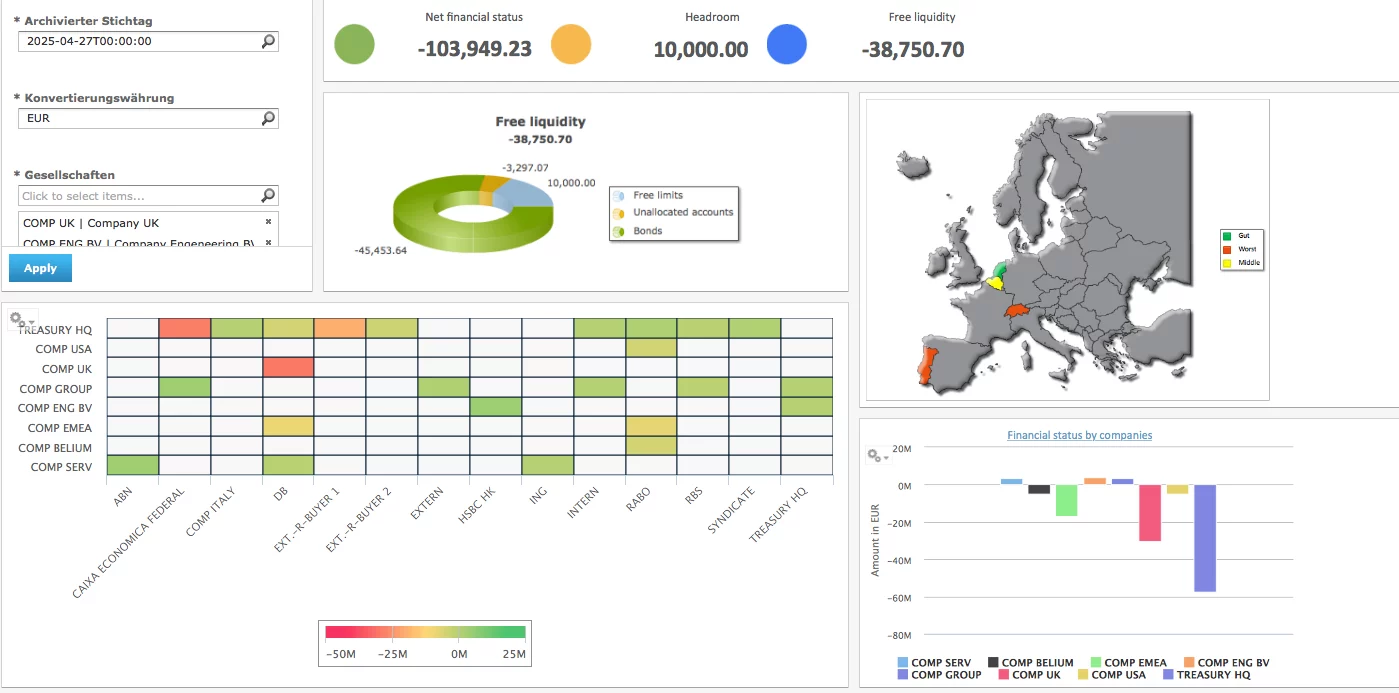
One of the key advantages of a Treasury Management System with a broad range of functions is the consolidation of all cash flows in a single database. The integration of the individual modules ensures that financial cash flows arising from financial transactions, pooling and clearing transactions, as well as interest and fee payments, are automatically reflected in the account-based cash forecast and in medium- to long-term liquidity planning. Operational cash flows from the company’s core business complete the basis for decision-making required for optimal liquidity management, which is a key responsibility of financial management.
The Cash Management Workbench and liquidity planning therefore serve as the primary points of reference for planning and safeguarding the company’s financial health. The financial status is also of particular importance, as it presents the current position in various formats tailored to the needs of different stakeholders.
A bank relationship overview should show which transactions, liabilities, investments and risks exist in relation to a bank or banking group, which costs the banking relationship has generated and where the most promising opportunities lie for upcoming negotiations.
The treasury modules also provide information on financing arrangements, securities positions, risks, maturities, terms and conditions, interest settlements and accruals, contingent liabilities, the utilisation and exceeding of credit facilities and limits, expected netting results, as well as overviews of authorised account signatories and the permission profiles of different users.
It quickly becomes clear that a Treasury Management System must, and can, provide far more information than might initially be expected. An integrated reporting system is available for these reports, providing access to all information stored in the database and enabling users to create flexible, multidimensional analyses.
Trinity TMS Functions at a Glance
Liquidity Forecasting and Planning
Flexible configuration of categories and time intervals (day, week, month, quarter, half-year, year)
Automatic population with cash flows from the treasury modules
Automatic currency conversion, including at historical exchange rates
Import of Excel templates with formulas
Any number of planning scenarios (best case, worst case, most likely, simulations)
Variance analyses (PLAN-to-PLAN, TARGET-to-ACTUAL)
Inclusion of credit facilities and exclusion of unavailable funds, or “trapped cash”
Global consolidation of financial plans across multiple levels
Inclusion of external data (planned transactions, bank statement items, market data)
Treasury Modules
Direct analysis through flexibly configurable module overviews
Filters, field selection and sequence, sorting and graphical presentations
Maturity lists, bank relationship overviews, exposure overviews, valuations, limit and facility utilisation, liability relationships, offsetting and settlement results, and much more
Cross-Module Reporting
Multidimensional analyses using intuitive pivot analysis tools
Direct access to the database
Graphical presentations
Drill-down functionality
Preconfigured dimensions for rapid report design
Up to 150 additional ready-to-use reports
Available in German and English
Distribution by email
Export in PDF or XLSX format
Optional: specialist reports, for example in accordance with IFRS, EMIR or FATCA
Optional: dashboards through integration with a BI tool
Benefits
Ready-to-use reports shorten the implementation project and deliver immediate added value
Rapid access to comprehensive and up-to-date information
Reporting requirements collected over more than 25 years and made available to all customers
Module integration enables the immediate use of all cash flows from financial transactions without duplicate data entry
Consolidation of all relevant data for all analyses
Verification of data sources and data entries through audit trails
Integrated authorisation system for individual user profiles
Option to monitor internal facilities and limits
Individually predefined filter templates enable reports to be accessed quickly
Errors are avoided through direct data transfer without duplicate entry
Reports can be distributed by email
Best Practice
To ensure that treasurers, cash managers and risk managers can quickly access the analyses they require, users see only the modules and data relevant to them after logging into Trinity TMS. Functions they do not need are hidden, making it easier to navigate the system quickly.
The clean and individually configurable home screen gives users rapid access to their daily processing screens. By selecting the relevant criteria in advance, they can immediately display the analysis they require. Frequently used selection criteria can be chosen quickly from drop-down menus or by entering the first few letters, while a calendar function is available for selecting reporting dates or periods. Recurring parameters and filter templates can be customised by individual users and saved for future use.
Pivot analysis offers even greater flexibility, particularly through the use of multiple dimensions and the ability to restructure them quickly using drag and drop. Many users are already familiar with this functionality from Excel and can begin creating analyses without requiring training. Trinity TMS also provides a highly useful drill-down function.
Depending on their assigned permissions, users can export reports as PDF or XLSX files, including the pivot parameters, and/or distribute them by email. All analyses can be saved as templates for individual users or user groups, allowing them to be retrieved quickly whenever required. The data can also be processed further for cross-functional analyses, for example in a business intelligence tool.
Depending on the module configuration, customers receive up to 150 ready-made report structures for typical analyses. As soon as the company data and financial transactions have been recorded in Trinity TMS, these ready-to-use reports are immediately available. Based on more than 25 years of experience, their rapid availability provides genuine added value for corporate treasury.