


Within the Treasury Management System, data is exchanged automatically between the modules. This means that all interest and repayment payments are immediately visible in the cash forecast and liquidity planning once a loan has been entered. Because all information is stored in a unified database, it is available for all analyses without having to be entered again. For this reason, Trinity TMS is referred to as an integrated system.
Integration also includes embedding the system into our customers’ existing system landscapes, because:
1
in addition to financial cash flows from financial instruments or transactions, operational cash flows are of course also required, such as expected incoming revenues, outgoing invoices, payroll and salary payments, as well as tax payments, in order to optimally manage and permanently secure the company’s liquidity. These data are usually transferred from various sources regularly and automatically via interfaces/web services in the background.
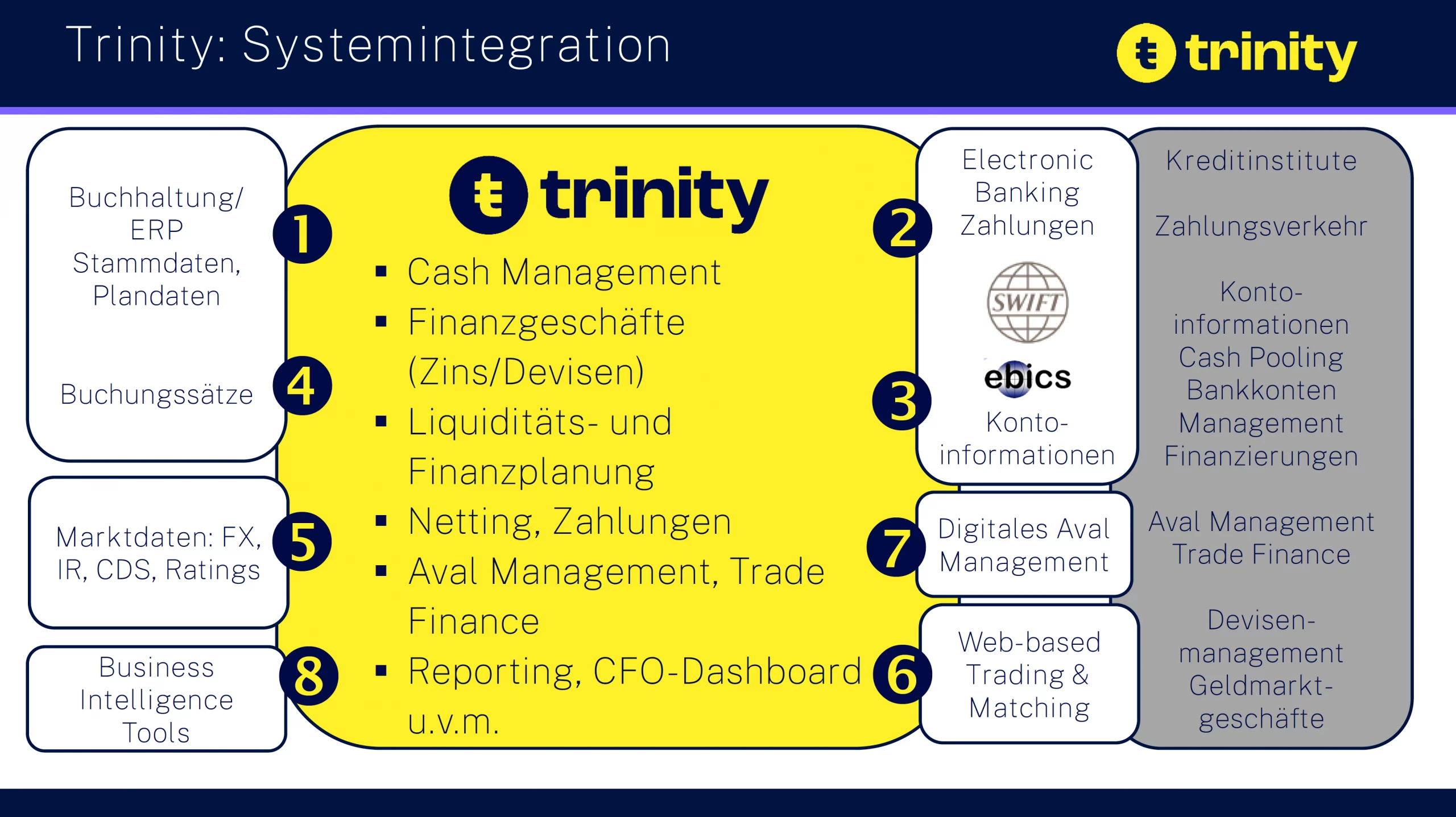
Connecting to systems within the company itself is only one part of the desired connectivity.
2
Examples of data coming from the treasury system include:
- payments from treasury transactions, internal receivables netting or daily cash positioning via previously defined Standing Settlement Instructions,
- reports or data for other systems and, where applicable,
- account statements for system-managed intercompany accounts or
- posting instructions as the basis for automated posting in the ERP system.
3
From external sources, the finance department is primarily interested in up-to-date account information, which in practice is already retrieved through various electronic banking solutions. Depending on the industry and the size of transaction volumes, this often also includes intraday advices for incoming payments.
4
The automatic reconciliation of planning data from internal data sources with the transaction data from bank account statements, which the Treasury Management System performs on a rule-based basis, can also be defined as the trigger for generating posting instructions for the ERP system. The account assignment module in Trinity TMS allows general ledger accounts to be assigned, so that all financial postings can be booked fully automatically in the accounting system going forward.
5
For currency conversion and mark-to-market valuation of financial and commodity forward transactions, foreign exchange rates, interest rates and yield curves as well as commodity price quotations, for example, are reliably imported in the background. Valuation formulas that include ratings, such as CVA/DVA, require appropriate credit default swap data. This type of information is offered by various market data providers, such as Infront, Refinitiv and Bloomberg, and can even be queried individually for each customer in Trinity TMS using configurable codes if required.
6
Internet trading systems such as 360T or FXall from Refinitiv are being used increasingly often, especially to process foreign exchange transactions quickly and in an audit-proof manner. Transactions concluded there can be downloaded directly into the treasury system immediately after execution and confirmed via corresponding confirmation matching services such as Finastra, FXall or Broadridge FinMAPP. As soon as the confirmation message is returned, the status of the transaction in Trinity TMS is set to “confirmed”. For customers with a very large number of foreign exchange transactions, the system even offers a pre-netting function specifically for FX transactions (“FX netting”) in order to minimize the number of chargeable transactions from a corporate perspective. Straight-through processing and integration with the services of credit and financial institutions as well as specialized financial service providers continue to advance steadily. In particular, the emergence of Application Programming Interfaces (API) and the entry of new market participants are creating significant momentum in the digitalization of financial management.
The EU’s second Payment Services Directive (PSD 2) has allowed companies to offer account information and payment initiation services and to make practical use of the relatively new API technology for this purpose. As a result, an alternative to the well-known EBICS standard has emerged, particularly among e-commerce providers. APIs for payments and account information, as well as for many other areas, are implemented by banks at different speeds and, above all, on an individual basis, meaning that cross-bank standards such as those available with EBICS or SWIFT are not guaranteed. A replacement in e-banking will therefore still take some time.
7
However, Trinity offers a meaningful use case for the digitalization of guarantee management, where our customer can use Trinity TMS and the REST API to submit guarantees directly from the Treasury Management System to guarantors for review and confirmation. More and more credit institutions and insurance companies are joining the guarantee platform of our southern German partner Digital Vault Services GmbH (DVS) and are available to issue guarantees and sureties. The application and amendment process is accelerated many times over, and the legally valid digital guarantees are securely stored by DVS. Alternatively, guarantees can also be commissioned from credit institutions via EBICS or SWIFT.
8
With regard to reporting and analysis options, the treasury system already offers a wide range of possibilities. Nevertheless, financial management sometimes needs to provide special reports, for example for reporting over-the-counter derivative transactions under the European Market Infrastructure Regulation (EMIR), as well as data for a company-wide BI tool for big data analyses. Trinity also offers solutions for these requirements.